
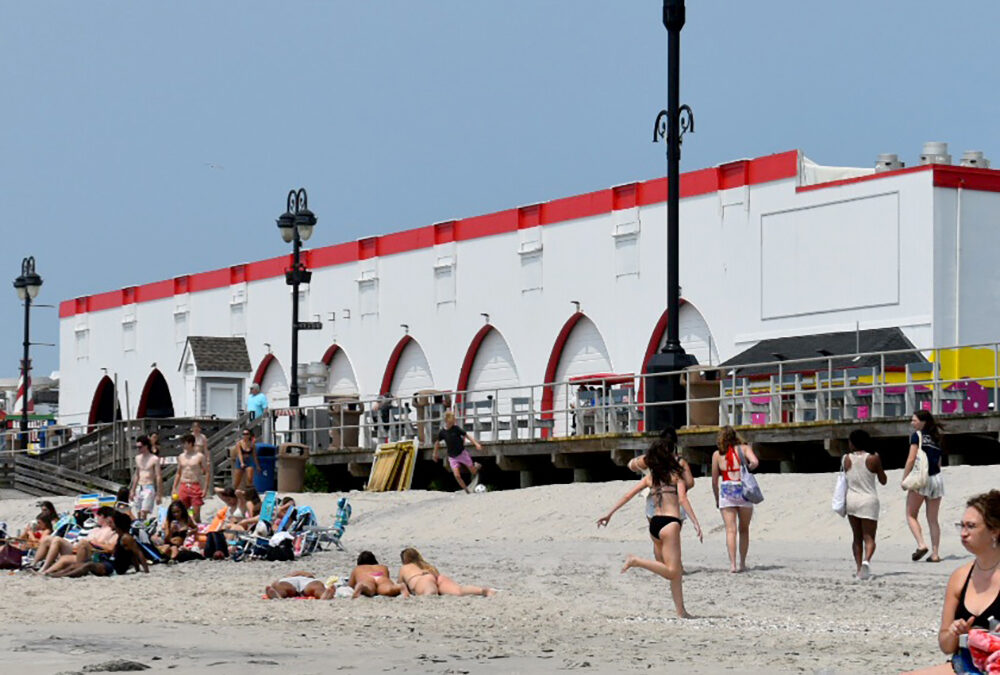
As debate continues over zoning and redevelopment around the future of 600 Boardwalk, a straightforward compromise has emerged that deserves serious consideration: split the parcel.
Keep the Boardwalk frontage zoned “on Boardwalk,” reserved for open-to-the-public attractions, and allow a hotel that complies with HZ zoning with an appropriate height respecting the historic community it abuts on the Wayne Avenue side.
This approach is pro-development with a practical safeguard. It draws a clear boundary between uses that are meant to serve the general public and those that cater to overnight guests. On the Boardwalk, where Ocean City’s identity and economy are rooted in accessible, family-oriented attractions, that’s an important distinction.
The need for a firm line becomes clearer when we examine developer Eustace Mita’s record as a zoning tactician. His projects repeatedly convert public-facing spaces into controlled, “velvet rope” environments where access is greatly limited by price, time and other policies.
Consider the Jan. 13, 2026 Avalon Planning Board meeting.
The Board approved a third-floor expansion at Mita’s Windrift property. The space functions as the “Icona Yacht and Beach Club,” where membership costs $7,500 annually. The public benefit offered in exchange was limited access for non-members two nights per week during the season. Even without knowing which nights those are, the implication is obvious: prime summer weekends are unlikely to be among them. What is presented as shared space becomes, in practice, highly restricted.
At the same meeting, the Board permitted the elimination of 15 self-parking spaces in favor of 24 valet-only spots, some of which extend into the public right-of-way. Where visitors once parked their own cars, they must now hand over their keys to a private valet operation occupying space that had functioned as part of the public realm. This is not a minor design tweak. It is a pattern of shifting control from public access to private management.
The precedent at Icona Diamond Beach is equally illuminating. The resort markets itself as “one of the only private beaches in New Jersey.” While the public technically retains the right to walk to and along the water’s edge, this right is often downplayed or obscured by hotel staff. This culture of exclusivity is enforced so aggressively that in 2021, police were called to the resort after staff confronted a beachgoer for attempting to set up a blanket on the “club’s section” of the sand.
The message is consistent: access exists on paper, but exclusivity governs in reality.
Even those who support bringing an Icona-branded hotel in Ocean City must account for this history. What kind of tourism model are we choosing? Ocean City has long thrived on broad-based, middle-class family tourism. The Boardwalk’s arcades, mini-golf courses, eateries and shops depend on volume and accessibility. A smaller pool of high-end guests does not necessarily translate into greater economic benefit. Ten families buying pizza, playing games and going on rides may well contribute more to the Boardwalk economy than a single yacht club member seeking a curated, insulated experience.
By supporting a hotel on the Wayne Avenue side that fits the scale of the neighborhood, the community is extending a real olive branch. It’s a way to welcome new hospitality while keeping a strict ‘firewall’ at the Boardwalk frontage. This communicates that Ocean City is eager to invite new investment while protecting the public character of our most iconic space. It ensures that attractions remain open, visible and genuinely accessible, rather than gradually transformed into exclusive, limited-access venues with nominal public concessions.
Zoning is not merely a technical exercise. It is the community’s most powerful tool for shaping outcomes.
At 600 Boardwalk, a clean split is the firewall Ocean City needs. The Boardwalk is OCNJ’s front porch: our collective, taxpayer-funded public living room. And in a town where actual front porches are increasingly being replaced by insular megamansions and seldom-used vacation homes, protecting the one porch we all still share matters more than ever. If we fail to draw that line now, we may find that what was promised as shared space becomes, step by step, something far more exclusive than our town has ever intended.