
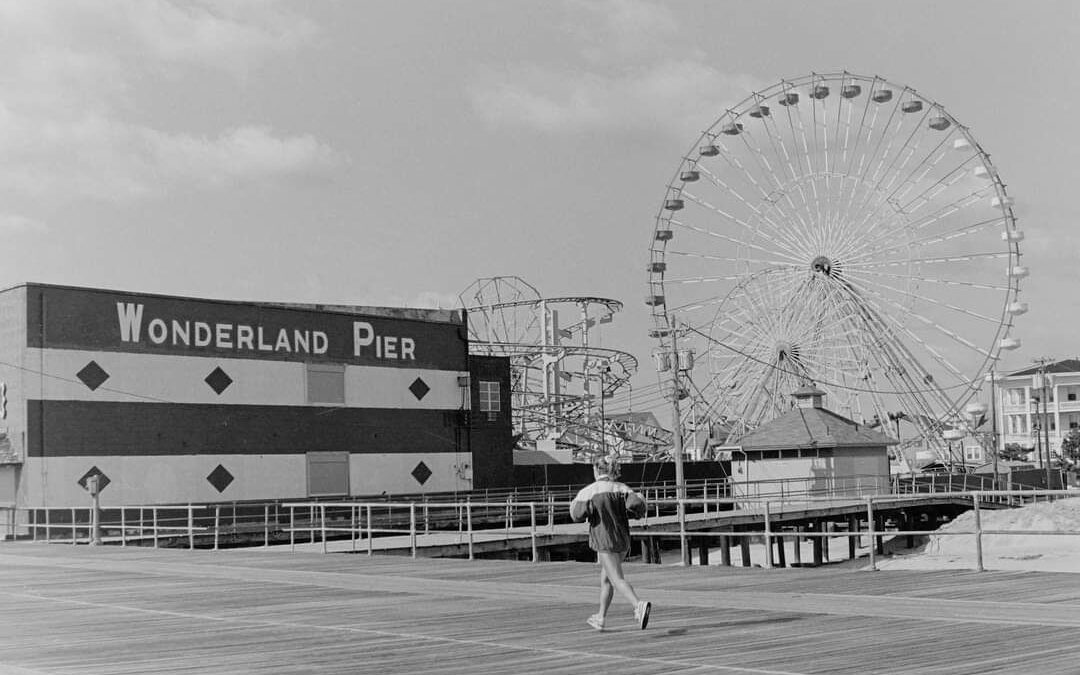
As debate continues over the future of the former Gillian’s Wonderland Pier property, a recently resurfaced 19th-century deed has drawn attention to longstanding restrictions tied to the iconic Boardwalk site. Local historians, however, caution that the document may have little bearing on present-day decisions.
Donna Saber, an Ocean City business owner and member of Friends of OCNJ History and Culture, uncovered an 1880s-era deed while researching the property’s ownership history.
The deed, originating from the Ocean City Tabernacle and the Ocean City Association, contains an extensive list of restrictions governing the use of the land. Those include prohibitions on alcohol, gambling, certain types of industrial activity, and even the placement of privies and stables — terms for bathrooms and parking, respectively, during that time.
Saber said the discovery stood out because the language in the deed repeatedly states that the restrictions apply “for all time.”
“To me, when I read the restrictions, the only thing that you can operate there is children’s amusements, because everything else is banned,” she said.
The deed traces the property’s lineage back to the Ocean City Tabernacle, a central institution in the town’s Methodist roots. According to Saber, the restrictions carried forward through multiple ownership transfers, including a 1997 deed from Howard Stainton’s estate to Gillian’s, operating under Gilamco, but the park operated under Stainton’s ownership since 1965.
However, Saber noted that when the property transferred again in 2021 — from Roy Gillian to 600 Boardwalk LLC — the deed did not explicitly restate those restrictions, a fact she said raised questions about how widely known or understood they are today.
The resurfacing of the deed comes amid ongoing public discussion about potential redevelopment of the former amusement pier site, including proposals involving hotel use. Some residents have argued that the deed could limit or complicate those plans.
John Loeper, president of the Ocean City Historical Museum’s board, said the deed Saber identified reflects restrictions that were once broadly applied across Ocean City — but does not, in his view, influence the current debate over Gillian’s Wonderland Pier.
Loeper explained that when Ocean City was founded by Methodist leaders in the late 19th century, similar restrictions were routinely attached to properties as part of the town’s moral and social framework. Many of the prohibitions — such as bans on alcohol — later became municipal ordinances, while others reflected concerns that are no longer relevant.
From a historical standpoint, Loeper also questioned whether the deed can even be definitively tied to the exact footprint of the present-day Wonderland Pier property, noting that lot lines, block numbers and even the Boardwalk’s location have changed significantly over time — particularly after the 1927 fire, which shifted the Boardwalk closer to the ocean.
While Saber believes the deed deserves closer scrutiny, she agrees that historians and legal experts will ultimately need to determine its relevance. Loeper, however, emphasized that from his perspective as a historian, the document does not alter the present discussion.
As Ocean City continues to weigh preservation, development and its historic identity, the rediscovered deed has added another layer — even as experts disagree on how much weight it should carry.