
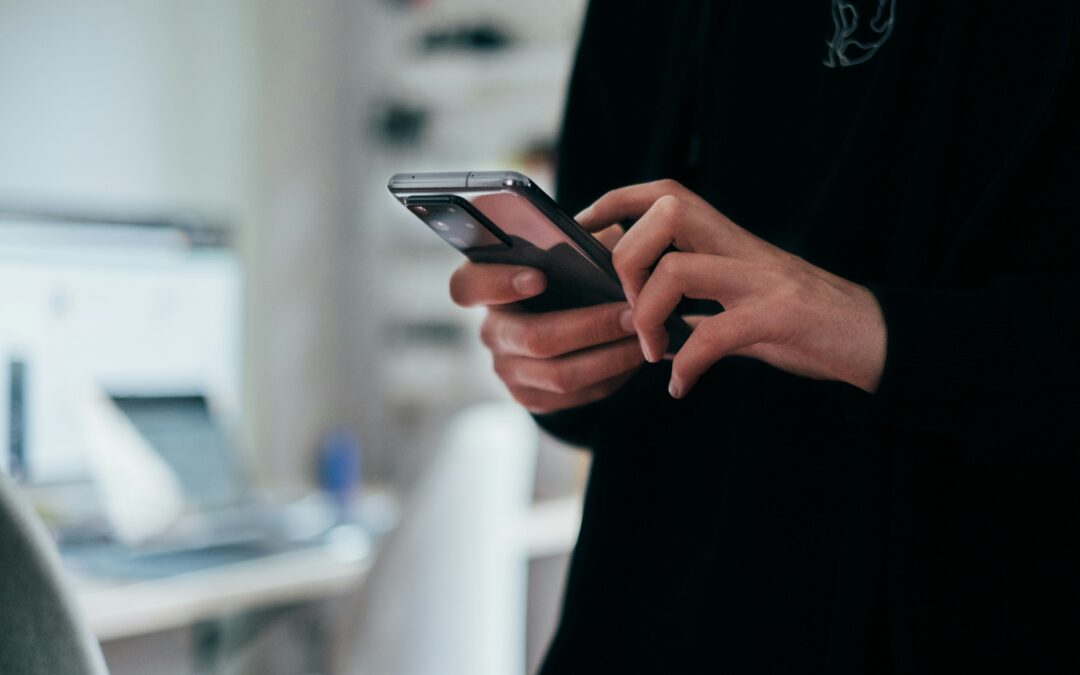
I left the house and forgot my phone the other day. For a minute, I had a mini panic attack. What if I need to reach someone? How can I check my texts or emails? Then it hit me. “Hold on a minute, Robin,” said the voice in my head. “You grew up without a cell phone. You started your career before cell phones were even a thing. You can survive this.” I laughed at how silly those thoughts were. Then, once I accepted there was nothing I could do about it, I actually relaxed. I didn’t need to send a text, find out what happened in the world during the few hours I was gone, or check my emails. It was almost a relief, a feeling of freedom.
If you’ve ever picked up your phone for no reason you can name, scrolled until you felt vaguely worse, put it down, and picked it back up 90 seconds later, welcome to the majority of the adult population. Smartphone addiction, or what researchers more carefully call “problematic phone use,” is now one of the most studied behavioral phenomena of the last decade. The more we learn about how it works, the harder it is to call it a weakness or personal failing.
The first thing to understand about your phone habit is that it didn’t develop by accident. The apps living on your screen were engineered, by some of the most well-funded behavioral design teams in human history, to be as compelling as possible for as long as possible. This isn’t a conspiracy theory. It’s a business model.
The core mechanism is what psychologists call a variable reward schedule, the same principle that makes those Atlantic City slot machines so enticing. When a behavior produces a reward at unpredictable times the brain responds by dramatically increasing the urge to repeat it. Every time we open Instagram, TikTok, or an email, we might find something exciting, funny, or validating, or we might find nothing. That unpredictability is the hook. Dopamine, the neurotransmitter associated with anticipation and motivation, spikes not when we find the reward, but when we seek the reward.
Former insiders have been candid about this. Multiple ex-employees from Google and Facebook have publicly confirmed that these techniques were deployed deliberately. One of Facebook’s founding presidents admitted the platform was built around the question: “How do we consume as much of your time and conscious attention as possible?” The answer: exploit a vulnerability in human psychology. Infinite scroll, pull-to-refresh, notification badges, autoplay, all of it engineered to keep us in the loop one more minute.
Knowing this doesn’t make it easier to stop. But it does make it less about willpower, and more about awareness.
What it’s doing to kids and teens
The picture for younger users is where the research gets most urgent. Adolescent brains are still developing and the prefrontal cortex, which governs impulse control and long-term thinking, is not fully formed until the mid-20s. That’s the part of the brain best equipped to put the phone down.
Psychologist Jean Twenge, who has studied generational shifts in mental health, found a striking inflection point around 2012, the year smartphone ownership crossed 50 percent among American teens. After that year, rates of teen depression, anxiety, loneliness, and self-harm began rising sharply, particularly among girls. Her 2017 book iGen drew a direct line between the smartphone era and what she called a mental health crisis hiding in plain sight.
There are several reasons. Heavy social media use correlates with sleep disruption, and teens who spend five or more hours a day on devices are 66 percent more likely to have at least one risk factor for suicide, according to recent research. Social comparison is amplified and constant. The normal awkwardness of adolescence now has an audience and a comment section. The face-to-face time traded for screen time appears to disrupt the development of social-emotional skills that only come from actual human interaction.
For younger children, screen time before bed suppresses melatonin production, delaying sleep onset and reducing total sleep hours, a serious concern since deep sleep is when the developing brain consolidates memory and processes emotion. The American Academy of Pediatrics recommends no screens in the hour before bed for children and teens. Most families will tell you, honestly, that they are not doing that.
What it is doing to adults
Adults have not been spared. The average American checks their phone 96 times a day — roughly once every ten minutes of waking life. That is almost hard to believe. Each check, even a brief one, fragments attention in ways that accumulate. Microsoft Research has found that after a digital interruption, it takes an average of 23 minutes and 15 seconds to return to a state of deep focus. We are interrupting ourselves constantly and then wondering why we can’t concentrate.
Sleep is the other major casualty. The blue light emitted by screens suppresses melatonin production in adults just as it does in children, but beyond the light itself, the content keeps our nervous system activated at exactly the moment it needs to downshift. Checking email at 10pm tells our brain the day’s work is not over and our brain, unfortunately, believes us.
There’s also a subtler cost that’s harder to quantify: the erosion of human interaction. Research has found that when a phone is visible on the table, even face down, even silent, it reduces the quality of in-person conversation. Both parties feel less connected, so the device doesn’t have to ring to do its damage. Yes, most of the time, the phones are not face down. We’ve all seen it at a restaurant: a group of friends or a family, sitting together, all silently scrolling on their phones, with very little conversation. Something is very wrong with that picture.
Steps that actually work
Make the phone boring. Most of us keep our most engaging apps, such as social media, news, and games, on the home screen, making them too easy to open on impulse. Move them into a folder buried two screens deep. Use grayscale mode, available on both iPhone and Android, which removes the visual reward of colorful notifications. Research has found that grayscale display alone reduces daily screen time for many users within a week.
Create friction, not willpower. Willpower is a finite resource and ultimately a losing strategy. Friction, making a behavior slightly harder to do, is far more effective. Charge your phone outside the bedroom. Delete the apps you use most impulsively and access them through the browser instead (the extra steps matter). Put it in a drawer during dinner. Physical distance is the lowest-tech intervention and among the most effective.
Set notification boundaries. Most notifications exist to pull us back into the app, not because the information is time sensitive. Audit your notifications aggressively: turn off all but the ones that require a genuine real-time response. Research on workplace productivity consistently finds that notification-free blocks of 90 minutes or more are among the highest-yield changes a person can make to their focus and output.
Name the trigger. Most problematic phone use happens in specific contexts: boredom, anxiety, the pause between tasks, social discomfort, or just a habit. Pay attention to when, not just how much, you reach for it. Substituting a different behavior at the trigger point, a breath, a brief walk, a book, a glass of water, is more sustainable than trying to just say no to picking up the phone.
For kids: model it first. Children’s screen habits are heavily influenced by parental screen habits. One study found that phubbing, using a phone during family interactions, was a stronger predictor of children’s problematic device use than almost any other variable. The most effective family screen policy, it turns out, is the one you actually follow yourself.
None of this is easy. These apps were engineered by some of the smartest people on the planet with one goal: to keep us from putting our phones down. They were not built for our wellbeing; they were built for our attention. Knowing that won’t make a phone addiction disappear overnight. But it might make us pause for just a second before we reach for our phones, and that one second gets us a step closer to taking back control.
Robin is a former television reporter for NBC News 40. She currently hosts a podcast and radio program called Living Well with Robin Stoloff. It airs Sundays at 10 AM on Lite 96.9. You can email Robin at livingwellwithrobin@gmail.com