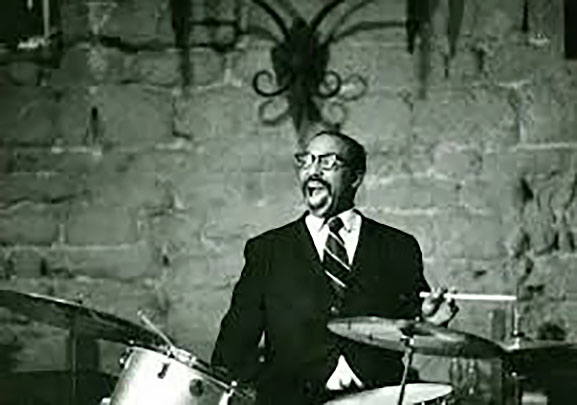
When fans of classic big band jazz gather, the talk invariably turns to the legendary drummers of yore who drove those ensembles. One of the names that seems to always come up is that of Sonny Payne, who spent 10 years with the band of Count Basie, 13 years with Harry James, and in between drumming for those two iconic bands, spent two years as Frank Sinatra’s personal drummer.
Payne learned from the best. His father was Atlantic City’s well-known and well-loved hide beater – as drummers used to be called – Joseph Christopher Columbus Morris, better known as Chris Columbus.
Born in Greenville, N.C., but raised in Atlantic City – he attended Indiana Avenue School and Atlantic City High School – Columbus took some lessons at Atlantic City High, but in terms of jazz drumming, he was self-taught. His first pro jobs, right out of high school, were in Atlantic City’s Northside at a long-forgotten venue called Truckson’s Hollywood Grill. He was good enough, at the age of 19, to catch the attention of famed bandleader Fletcher Henderson and joined that iconic band in 1921.
Columbus then moved to New York City where he played with a number of groups, including those of Louis Jordan and Louis Armstrong, and had a residency of several years, sometime in the 1930s, at Harlem’s famed “home of happy feet,” The Savoy Ballroom, as well as the Apollo Theatre.
Stories differ on how – and when – but Columbus was lured back to Atlantic City. Some reports claim he moved back to the shore in the late 1930s, but it’s more likely that Club Harlem owner Leroy “Pop” Williams made Columbus an offer he couldn’t refuse sometime around 1944: A residency each summer as leader of Club Harlem’s house orchestra. Columbo stayed for an astounding 34 years until Club Harlem’s doors closed in 1978.
It wasn’t an easy job by any means, but it had to be fun. As leader of the house band, Columbo had to back hundreds of headliners, from Sammy Davis Jr. to Nat “King” Cole, as well as conduct for the popular floor show, “Larry Steele’s Smart Affairs,” which ran at Club Harlem from 1946 through 1964. No doubt, in the course of the evening, Chris Columbus had a couple of featured spots at the drums.
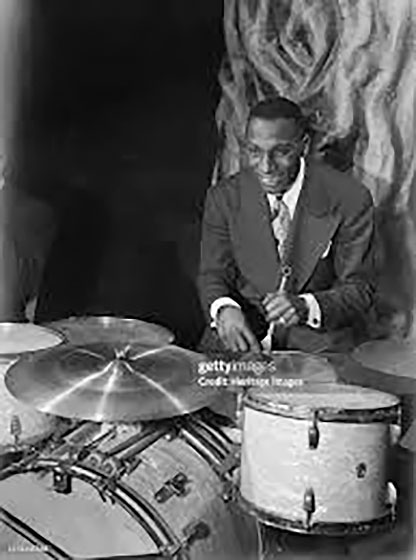
He was in demand and quite busy during the off-season as well, playing with the likes of Cab Calloway and Eddie “Cleanhead” Vinson, recording with Duke Ellington and Dizzy Gillespie, and off and on for years with jazz organist Wild Bill Davis, who also had a long residency in Atlantic City at Grace’s Little Belmont.
Stylistically, Columbus was a master of playing the “jump blues shuffle beat,” later appropriated by several of Louis Prima’s drummers, which was a requirement during the days he was with Louis Jordan. The several recordings he made as a leader in later years reflect his love for jump blues and for that special beat. It’s important to note that in the early-to-mid-1940s, music by artists like Jordan and Columbo were precursors of what was later known as rhythm and blues.
“If you ever saw him from the balcony, you’d swear he was perched on a mountaintop, looking down on the set like a general surveying his troops,” said Bill King, a one-time writer for music trade magazines Billboard and Cashbox. “Snapping the snare, kicking the bass, pushing the time like a locomotive bound for a town that didn’t know it was about to be invaded by swing. You couldn’t hide that beat. He was the snap, crackle and pop of jump blues before breakfast. Chris Columbus was a bridge – from big band to jump blues to proto-rock ‘n’ roll. He was in the bloodstream of the music before most drummers knew where to put the needle.”
Columbus, evidently, was also quite the showman, something that his son – Sonny Payne – became known for. A longtime customer of Club Harlem and a Columbus fan recorded these memories not long ago for a mini-documentary on the club:
“Chris was a really big guy, and he had this unique drum stool that he used to sit on. It was a big motorcycle seat from a Harley-Davidson that was on a spring. He would sit there and play and sit on this big motorcycle seat, and bounce up and down on this spring that was attached to it. Club Harlem? This place used to cook!”
Columbus didn’t slow down for a second after Club Harlem closed. He hosted his own radio show on Atlantic City’s WFPG, where he was said to be that station’s first African-American disc jockey, served as vice president of the city’s Local 661-708 Musicians’ Union, and performed, on and off, with a Dixieland band at the Showboat. Though never formally documented, Columbus also returned to Louis Jordan’s outfit in the late 1960s through the early 1970s. He performed at the Showboat until he suffered a stroke in 1993.
Chris Columbus died on Aug. 20, 2002. He was 100 years old. Three years later, a section of Kentucky Avenue, near where Club Harlem once stood, was renamed Chris Columbo (his show name) Lane.
“You don’t forget the ones who can do that,” wrote Bill King. “You just keep counting yourself lucky you ever stood in their shadow and felt the floorboards move.”
In other words, as it pertains to Chris Columbus, the beat goes on.