The great cabaret performer Eddie Bruce once introduced me on stage by saying, “There’s a lot of guys out there who do Sinatra. Klauber is one of them.”
While I like to think of myself as a singer who carries on the jazz spirit of Mr. Sinatra, as opposed to one of the guys who “does” Sinatra, this got me thinking about all the fellows out there, past and present, who “do,” or “have done,” Frank Sinatra. All, by the way, are, or were, frequent performers in the Atlantic City and Jersey Shore region.
Some of those names include the late and great Sonny Averona and Billy Ruth, young Brandon Tomasello and Zach Taglioni, Tony Sands, Steve Ritrovato, Bob Anderson, and one of the busiest of all, Michael Martocci, who was, for a brief time, endorsed by Frank Sinatra’s manager, Eliot Weisman. All are good at what they do, but none of them would consider themselves “impersonators;” interpreters would be more like it.
There was a long-forgotten performer, however, who not only considered himself to be a Frank Sinatra impersonator, but was among the first. Those who were fortunate enough to see and hear him perform, including me, say he was the best.
His name was Duke Hazlett. In 1959, my parents were celebrating their 15th anniversary at a legendary Philadelphia nightclub called The Celebrity Room, owned by the notorious, mob-connected Lillian Reis. Given the occasion, my father secured front-row seats.
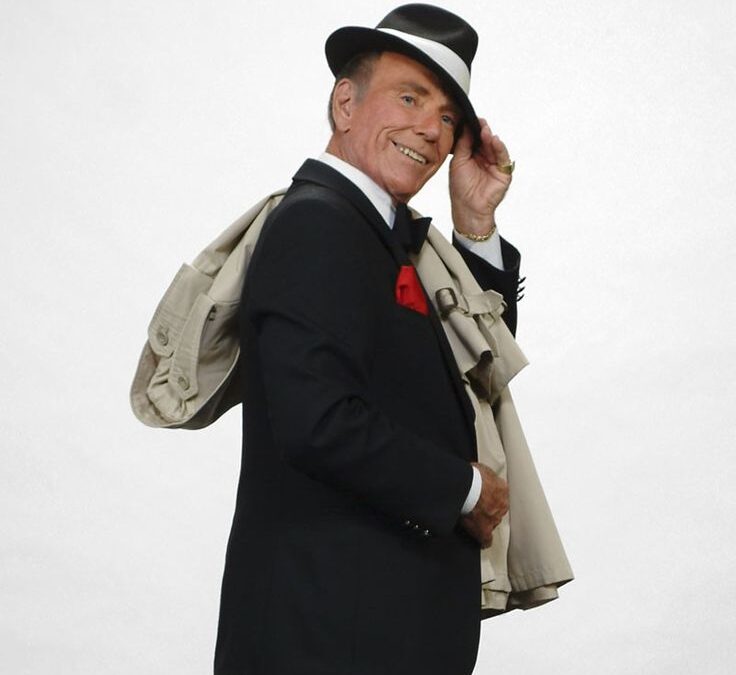
Duke Hazlett was the headliner. When he came on stage, wearing the famed Sinatra outfit of a hat and raincoat, there were gasps from the audience who, for a split second, thought Duke was Sinatra.
As a 6-year-old, I was having a ball watching this guy, and watching the grown-ups who were enjoying Hazlett’s vocal renditions of Sinatra hits like “All the Way.” Given that I was close enough to touch the stage, I took advantage of that rare opportunity until Hazlett, sometime in the middle of the show, addressed me directly by asking, “Are you in showbusiness, kid?” I answered sheepishly, “No.” Hazlett’s reply? “Then get your damn hands off my stage!”
I was in heaven, I was part of the act, and yes, that was the moment I knew that showbusiness would be my life.
Like Sinatra, Hazlett was first mesmerized by Bing Crosby. In a 2009 piece for the Branson Missouri Tri-Lakes News, Hazlett told writer Joshua Clark, “As a child growing up in California, I always knew I wanted to be an entertainer. I used to ride by Bing Crosby’s house every day on my way to shine shoes. I always wanted to be a part of that world.”
As a youngster, he joined Robert Mitchell’s Boys Choir, which made appearances in more than 100 motion pictures, including “Going My Way” and “The Bishop’s Wife.”
He didn’t start emulating Sinatra until he joined the Air Force at the age of 18, when he became a member of Air Force Special Services.
His initial taste of the big time came while performing for the troops in Germany, likely in the early 1950s. Evidently, said Hazlett, Frank Sinatra, Ava Gardner, Tony Curtis and Janet Leigh were scheduled to perform for the servicemen, but Sinatra and Gardner never showed up. Hazlett’s major, having heard him do his Sinatra bit, told him to get out on the stage and do his thing.
He was a hit. Upon his discharge, he began working nightclubs, including the influential LaRonde in the San Fernando Valley where a young Don Rickles was holding court. This led to some national exposure, including a television stint on “The Steve Allen Show” in 1958. That video clip can be seen today on YouTube.com, and many of those who view it continue to claim, “That’s Frank Sinatra!” It isn’t; it’s Duke Hazlett.
The Allen appearance led to more national exposure, including appearances as a frequent guest on the “Tonight Show” starring Jack Parr, where he became one of Parr’s favorite guests – and performances in Las Vegas and at the nation’s most prestigious clubs.
Hazlett began to get offers to perform around the country. He played the main room at the Tropicana in Las Vegas and began playing Chicago and New York.
Around 1960, he made a connection with Playboy Magazine’s Hugh Hefner. It was a lucrative association, as Hazlett worked the Playboy Club in Chicago and other Playboy nightspots as the circuit began to expand in 1961.
He worked frequently in Las Vegas and in Atlantic City in the years following, and even made a couple of recordings for a small label which are pretty good. He frequently appeared at Le Bistro in Atlantic City, a nightspot which was briefly popular in the late 1970s, but is best known as the venue that Donald Trump bought in 1982 from Le Bistro owner, and alleged mobster Sal Testa. Trump paid more than $2 million for the club, which had been sitting vacant for a few years – as he needed more room for his Trump Plaza Hotel and Casino project.
Wherever he worked, Hazlett was fond of telling the story about working in a club “next door” to the real Frank Sinatra. Hazlett claimed that in 1978, he was performing at Le Bistro while Frank Sinatra was appearing next door at the 500 Club.
“It was great playing next door to a sold out show,” said Hazlett at the time. “In addition to my normal crowds, everyone who couldn’t get in to see Sinatra came over to see me. We played to standing-room-only crowds.”
The issue is that it never happened, as the 500 Club burned down in 1973. However, it may have happened in 1979 when Sinatra was appearing at Resorts International and Hazlett was at Le Bistro. And yes, Hazlett claimed to have known Sinatra, however slightly.
“We weren’t great friends, but we knew each other and we would always speak when we had the chance,” Hazlett said.
In the late 1980s, Branson, Missouri had become a haven for performers of a certain age. Duke Hazlett was one, and for the next 15 years, he was a member of the “Legends in Concert” franchise in and around Branson.
In 2006, he began doing his one-man show, “Reflections of Ol’ Blue Eyes,” in Branson and elsewhere.
When publicizing that show, Hazlett’s tag-line was, “If you like Sinatra, you’ll love Duke.” He often joked that Sinatra would sometimes open his show by telling the crowd, “If you love Duke, you’ll go cuckoo over me.” That also likely never happened.
In a 1999 article for the Phoenix New Times newspaper, Hazlett told writer Dewey Webb, “People have said to me that when Frank dies, I’m going right up into the six-figure bracket.”
That probably didn’t happen either. But when we talk about those who “do” Frank Sinatra, Duke Hazlett was the first, and the best. I know. I heard him.
Start spreading the news
Those who want to learn more about the incredible career of the “real” Chairman of the Board may want to sign up for “Sinatra 101,” a series of three classes I’m teaching this summer as a part of Stockton University’s Friends of Encore Learning Series (FELS). Interested parties can sign up by way of the FelsStockton.org summer catalog, which will be released soon.
Bruce Klauber is the author of four books, an award-winning music journalist, concert and record producer and publicist, producer of the Warner Brothers and Hudson Music “Jazz Legends” film series, and performs both as a drummer and vocalist.