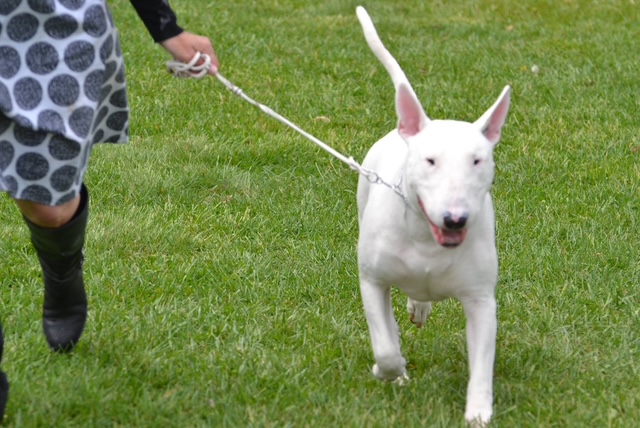
If you want your puppy to walk nicely on a leash, you should start the training process as soon as you get them. Picking the right equipment to train your puppy with is the first piece of the puzzle of teaching them to walk nicely.
My collar of choice is a martingale collar, which is also known as a “no-slip” collar, meaning that it will tighten up without choking your dog and that they can not slip out of it.
Martingale collars slide over your dog’s head. I am not a fan of buckle collars, as I have heard many horror stories of dogs backing out of them and escaping. Martingale collars do come with a quick-release clip if you need to release the collar from a dog’s neck and are unable to slide it off. They also come in a variety of widths to fit most dogs’ necks. My Bull Terriers wear collars that are 18-24 inches in diameter and then one inch in width. Don’t rush to purchase a harness right away; I only use a harness if the puppy is really out of control and absolutely needs it to prevent them from pulling. If you start off with simply using a martingale and reinforce what you want, you probably will not need any additional equipment.
I use a regular six-foot leash and never a retractable leash. Retractable leashes are not only bulky in my hand, but they do nothing but teach your puppy to pull. To hold a leash correctly, you will put your thumb through the loop. Then, to make it shorter, try balling the leash up inside your fist or palm. Avoid wrapping it around your wrist. I like a soft leash to do this with, so I have velvet-trimmed leashes that are about a half-inch wide. Remember, no matter how thick the leash is or how many handles it has on it, it’s the training of the puppy that will actually stop them from pulling.
As I stated, the first step in teaching a puppy to walk nicely is to have a vision of what you want leash walking to look like with your dog. This is helpful because while working towards that final picture, you will be breaking this picture down into individual frames, rewarding one skill learned at a time. And when teaching a baby puppy to walk nicely, it is helpful to remember that it is not about how far you walk them, it is about how good the walk is. I start leash walking training in my own yard, where the distractions are minimal and familiar. I am always armed with treats that are incredibly rewarding, like chicken or beef.
The first step before you move is to be organized and ready to both verbally praise your puppy and to treat them from the non-leash hand when they are giving you what you want. This may seem like a cumbersome production, so just standing still and getting ready is absolutely a part of the training process. Next, pick a side that you want your puppy to walk on. I am left-handed, so my leash and the puppy are on my left, and the treats are in my right hand. My puppies do not get to walk at the end of the full six-foot leash right away. So I take a second to get the leash folded up inside my hand to the length I want it and my treats ready before moving.
My next step is simply to stand and be quiet. I wait for my puppy to look up at me and give me that automatic check-in I love to see before moving. If your puppy is staring wildly off into the distance and is completely distracted, adding movement to that will only result in them barging to the end of the leash, and they will start to pull you. Waiting for the automatic check-in, and then rewarding it, will cement that looking at you for guidance and further instruction is the start of all walks.
If you have any questions, please feel free to email me at heidi@fouronthefloordogtraining.net.
Heidi Clayton started Four On the Floor Dog Training to provide positive, reward-based dog training in South Jersey. She breeds, trains and shows bull terriers under the SoraBully’s Bull Terriers kennel name. Email questions to heidi@fouronthefloordogtraining.net or learn more at https://fouronthefloordogtraining.net