As we prepare to celebrate the 250th anniversary of the Declaration of Independence, it brings to mind another struggle for freedom that began a mere 50 years ago, right here in South Jersey.
In 1976 the Burlington County Herald – a weekly newspaper in Mount Holly – lit a political fuse when editor/publisher Albert Freeman wrote a column in the spirit of the Bicentennial, suggesting that South Jersey secede from New Jersey to form the 51st state.
In his column, Freeman lamented that state money was being poured into the new Meadowlands Sports Complex in East Rutherford, while the struggling Garden State Race Track in Cherry Hill was being ignored. He also complained about the lopsided representation on the state’s boards and commissions, noting that the Supreme Court, Governor’s Cabinet, Economic Development Authority, Highway Authority, state Board of Education and even the Atlantic City-dependent Casino Control Commission were all stacked in favor of the north.
“We’re tired of paying taxes that end up in northern New Jersey,” Freeman told the Associated Press. “We want our destiny planned by ourselves and our neighbors.”
Freeman’s initial call to secede may have been tongue in cheek, but the issue was no joke as more and more people stepped forward to support him. He raised money, selling “Citizen of South Jersey” certificates for $1 each. The campaign quickly raised more than $4,000. It was clear that he had struck a nerve.
As his cause gained momentum, there was a push to get a non-binding secession referendum on the ballot in the eight South Jersey counties.
The belief that Trenton was bullying South Jersey went viral on Feb. 8, 1979 when Democrat Gov. Brendan Byrne signed a building moratorium barring new construction in the 1.1 million-acre Pinelands National Reserve, which is almost entirely located in South Jersey. Byrne’s moratorium put a development padlock on 22% of the state’s land mass. People were angry.
“Cries of ‘Let’s secede’ and ‘Impeach Byrne’ echoed in the Louden Fire Hall in Waterford Sunday afternoon,” the Courier Post reported Feb. 19, 1979. “Two hundred fifty builders, property owners, and elected officials pledged to fight Governor Byrne’s recent Pinelands building moratorium.”
The moratorium was in place until the Pinelands Protection Act was enacted, creating the regulatory framework we are familiar with today, including the Pinelands Commission and the Pinelands Comprehensive Management Plan. While successful in safeguarding the 17 trillion-gallon Kirkwood-Cohansey Aquifer, it did so at the expense of property rights and individual freedom. The act radically curtailed growth in some places, and funneled it toward others, using a system of Pinelands development credits.
The new policies deprived communities of home rule. Many felt it was time to take action. Among those moved to do something about it was Joel Jacovitz – a builder, New York transplant and deputy mayor of Egg Harbor Township.
In April of 1980, Jacovitz convinced his Egg Harbor Township Committee colleagues to become the first municipality to support Freeman’s statehood crusade. As other communities followed, the number of communities supporting the cause surpassed 50.
Jacovitz organized a secession convention in July of 1980 where the Committee to Free South Jersey was born. It expanded, growing to more than 8,000 members dedicated to gathering petition signatures to place a non-binding secession referendum on the November ballot in all eight South Jersey counties.
On Nov. 4, 1980, a non-binding question appeared on the ballot in six of the eight South Jersey counties, with the county governments (then known as freeholders) of Camden and Gloucester counties declining to participate.
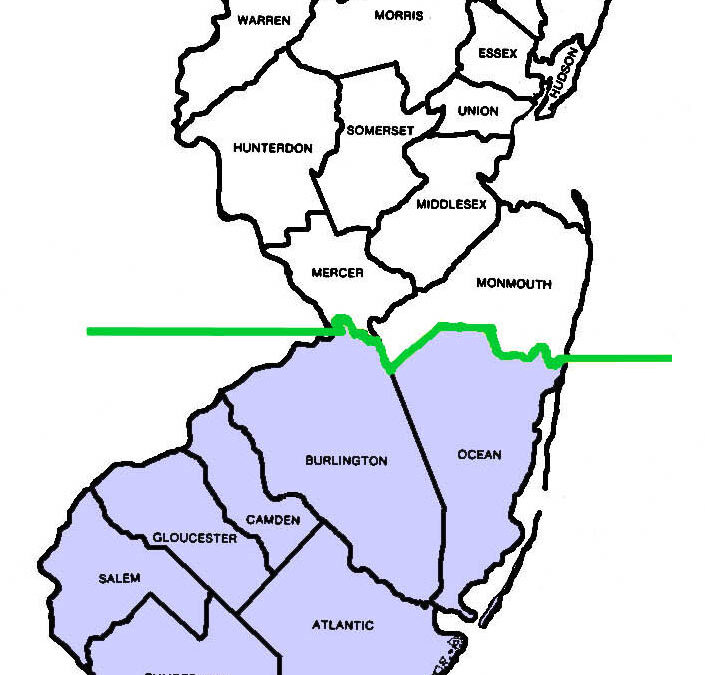
It asked voters if Atlantic, Burlington, Camden, Cape May, Cumberland, Gloucester, Ocean and Salem counties should request permission from the state Legislature to secede and form a new state. What would the new state look like? Freeman suggested a state partition along the northern borders of Burlington and Ocean counties, separating 1.8 million South Jersey residents from the 5.4 million living in the north.
“Monmouth and Mercer counties are both New York-oriented. We’re more Philadelphia-oriented,” Freeman told the AP.
Reports varied on where the state capital would be located in the new state of South Jersey. Freeman said South Jersey has everything it needs to be a separate state with Camden as its capital. Jacovitz envisioned a successful South Jersey with Atlantic City as its capital, thriving on tourism, casino gambling and offshore oil drilling.
On election night Tuesday, Nov. 4, 1980, South Jersey secession squeaked in, taking just under 51% of the vote with 180,663 votes in favor, vs. 174,151 votes against.
Results by county were:
- Salem County: 72%
- Cape May County: 62%
- Cumberland County: 59%
- Ocean County: 59% against
- Atlantic County: 53%
- Burlington County: 52%
“We sent a message to Trenton. We weren’t going to let them bully us anymore,” Jacovitz said of the election. “We were prepared to fight back.”
The vote was also transformative for the nation. Ronald Reagan defeated Jimmy Carter in a landslide, marking the beginning of a new conservative era in American politics.
The secession movement’s momentum set the stage for the 1981 gubernatorial race in which North Jersey Republican Tom Kean beat South Jersey Democrat Rep. Jim Florio by a nose in what remains the narrowest gubernatorial election in New Jersey history, winning by just 1,797 votes following a recount. Even though he was a representative from South Jersey’s 1st District, Florio didn’t have the support of the Committee to Free South Jersey, in part for his role in the creation of the Pinelands National Reserve.
Secession within states has happened before. In 1820, Maine was part of Massachusetts when it formed its own state. And in 1863, during the Civil War, West Virginia became a state when it left Virginia. Others have tried and failed including Northern Michigan and Southern California.
But South Jersey statehood was never taken seriously in Trenton. At the time, Gov. Byrne called the South Jersey statehood movement “a bunch of rabble rousers.” In reality the quest never stood a chance because it needed more support than what was possible from six sparsely-populated, malcontent counties. It also required unlikely support from the state Legislature and Congress. But just because a new state wasn’t created, doesn’t mean it was a failure. It became a force to be reckoned with which had an impact on the race for governor in 1981.
“From its slapstick beginnings, the committee evolved quickly into an organized, disciplined, professional group of political zealots,” The Inquirer wrote. “With 9,000 foot soldiers in its rapidly growing army of independent-thinking voters, it has gained respectability as well as political firepower.”
“Our group means business. Ask Florio,” Jacovitz told The Philadelphia Inquirer. “We actively opposed Florio’s campaign because he ignored us and because he didn’t take a stand on any issues. Florio expected to carry South Jersey by 140,000 votes. Well, he walked away with only 60,000. There’s no question in my mind our membership made the difference.”
Beyond simply endorsing Kean’s run in 1981, Free South Jersey funded 250 radio spots and distributed 120,000 issues of its publication, South Jersey Alert, noted The Inquirer. Their efforts proved effective down-ballot as well, with 20 of their 30 endorsed candidates securing seats in the Senate and Assembly.
Decades after the North/South Jersey dust-up the beat goes on between the state’s two halves. Case in point is the 2026 pursuit of gaming by North Jersey legislators who don’t seem to care that North Jersey casinos could devastate the economy in South Jersey.
Resolutions working their way through the state Senate aiming to strip Atlantic City of its gaming monopoly could put the fate of proposed Meadowlands and Monmouth Park casinos directly before voters as early as this November.
Harry Hurley, longtime South Jersey political analyst, columnist and radio talk show host notes that everything seems to function in Trenton based on what suits the North Jersey agenda. He said we shouldn’t be surprised.
He noted that gaming didn’t happen in 1974 when it was a statewide question and when South Jersey wanted it. It had to wait until 1976 when North Jersey could keep it safely tucked away in Atlantic City. Now that it is flourishing here, North Jersey wants a piece of the action, which means from now on, “South Jersey must forever fight against legalized gaming in North Jersey.
“North Jersey didn’t want it then. And we don’t want it for them now,” Hurley said.
As for Jacovitz, his wish to have a seat at the South Jersey political table was granted shortly after the secession vote with an appointment to the New Jersey Pinelands Commission as Atlantic County’s representative, named by the then-Atlantic County Board of Chosen Freeholders.
He served on the commission from 1980 to 1984 before running for the General Assembly in 1985 as a Democrat. He came in a distant third, decisively defeated by Republicans Ed Cline and Dolores Cooper. He died in 2017, although the idea of a separate South Jersey did not die with him.
The notion that South Jersey is the forgotten stepchild of the north lives on in a change.org petition posted by Nicholas Blade Hopwood calling for the creation of a separate South Jersey.
“Emerging as the 51st state would empower South Jersey to forge a path reflecting its identity, free from the imposing influences of North Jersey,” the petition states.
Sound familiar?
Copy editor and Contributing Writer James FitzPatrick has been a community journalist in Atlantic and Cape May counties for more than 30 years, including 20 years as editor of The Current Newspapers. He lives in Hammonton.