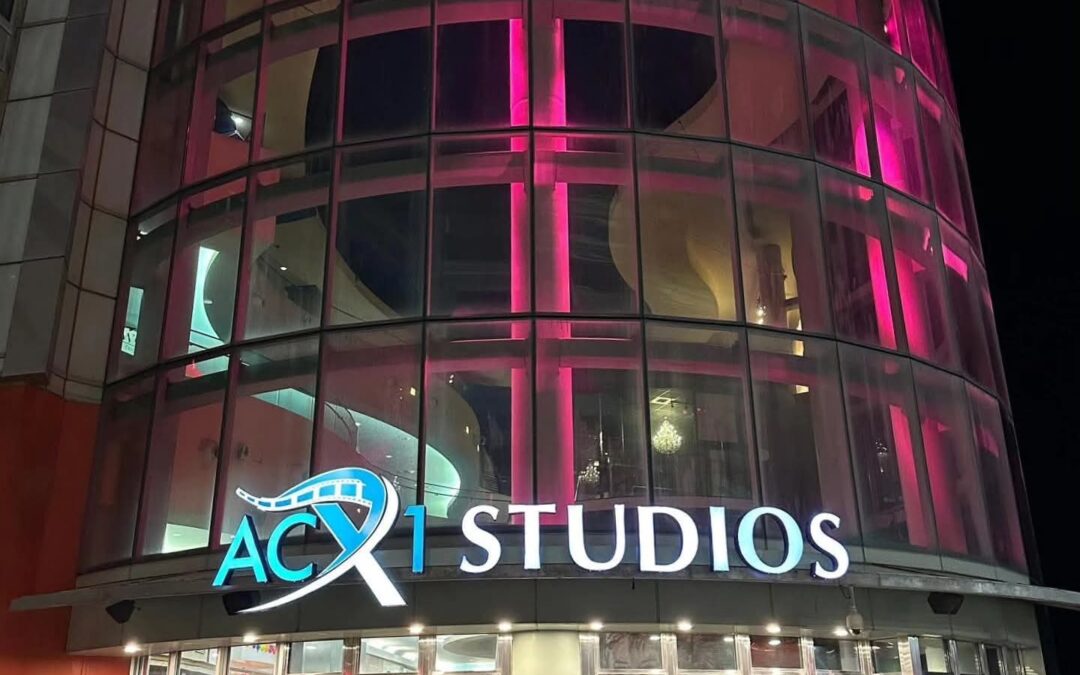
Just three years after bold promises to transform the Jersey Shore into a hub for film and television production, ACX1 Studios has filed for Chapter 11 bankruptcy, casting doubt on the city’s ability to reinvent itself beyond gaming and seasonal tourism.
The filing, made March 13 in U.S. Bankruptcy Court, allows the company to restructure its debts while continuing operations, signaling serious financial strain for a project once touted as a cornerstone of Atlantic City’s economic diversification.
Located on the storied Boardwalk pier once known as The Playground Pier, ACX1 Studios moved into the space in 2023 with sweeping ambitions. Developers envisioned a 550,000-square-foot production complex capable of hosting dozens of film sets, music production facilities and entertainment venues. All efforts were aimed at branding Atlantic City as the “Hollywood of the East.”
That vision, now dimmed by bankruptcy proceedings, reflects a broader pattern in Atlantic City: big ideas colliding with economic reality.
The ACX1 site is no stranger to reinvention. Over more than a century, the pier has cycled through various identities – from the Million Dollar Pier in the early 1900s, to The Pier Shops at Caesars and later Playground Pier – each iteration promising to capture a new generation of visitors.
Despite a prime oceanfront location and direct access to Caesars via a skybridge, the property has struggled to sustain long-term success. By the late 2010s, it had become what many described as a “dead mall,” plagued by vacancies as retail shifted online and foot traffic declined.
ACX1 represented the latest attempt to break that cycle, pivoting away from retail toward entertainment production. But its bankruptcy suggests the challenges facing Atlantic City extend beyond any single concept.
New Jersey has aggressively pursued film and television production in recent years, offering generous tax incentives to lure studios from New York and California. Projects like the Netflix facility at Fort Monmouth have shown promise, and industry leaders have pointed to the state’s diverse landscapes and proximity to major New York and Philadelphia markets as key advantages.
In 2018, then‑Gov. Phil Murphy signed legislation reinstating and expanding the state’s film and digital media tax credit program, which offers a 30% base credit. Even more enticing, the state would extend the credit to 35% for productions that spend money with vendors in certain South Jersey counties, including Atlantic County.
Still, Atlantic City presents unique obstacles. Unlike established production hubs, the city lacks a deep ecosystem of film crews, soundstage infrastructure and year-round industry activity. While ACX1 aimed to build that workforce from scratch, doing so requires sustained investment, steady bookings and long-term confidence from studios – all difficult to secure in a volatile entertainment economy.
The timing may have also worked against the venture. Shifting streaming strategies, disruptive AI technology and cost-cutting measures across the industry have reduced production spending in recent years, tightening budgets for emerging studio spaces.
ACX1’s lack of success is more than a single business failure; it underscores the city’s ongoing struggle to redefine itself without major success. Developer Bart Blatstein has made several attempts to shift that narrative, including the purchase of the pier in 2011.
Atlantic City has spent more than a decade searching for stability after casino revenues declined and several properties shuttered in the 2010s. Efforts to diversify into nongaming attractions, such as retail and other forms of entertainment have brought mixed results.
For local leaders, the promise of a film industry was especially appealing. Production would bring not only jobs, but also year-round economic activity, a critical need in a city still heavily reliant on summer tourism. Without a successful anchor like ACX1, that vision becomes harder to realize.
Chapter 11 does not necessarily mean the end of ACX1 Studios. The restructuring process could allow the company to reduce debt, attract new investors or pivot its business model. Still the bankruptcy casts a shadow of uncertainty over one of the Boardwalk’s most prominent properties.
The larger question is whether Atlantic City can sustain the kind of long-term, coordinated investment needed to build a film industry from the ground up, or whether it will continue its pattern of ambitious projects that struggle to gain traction.
For now, the pier stands as both a symbol of possibility and a cautionary tale: a prime location with a history of reinvention, still searching for an identity that lasts.
Atlantic City is once again left asking what comes next for one of its most visible and elusive comeback stories.
Sarah Fertsch of Egg Harbor Township holds a Bachelors of Arts in Public Relations. She is a locally renowned poet, storyteller, and dog lover.