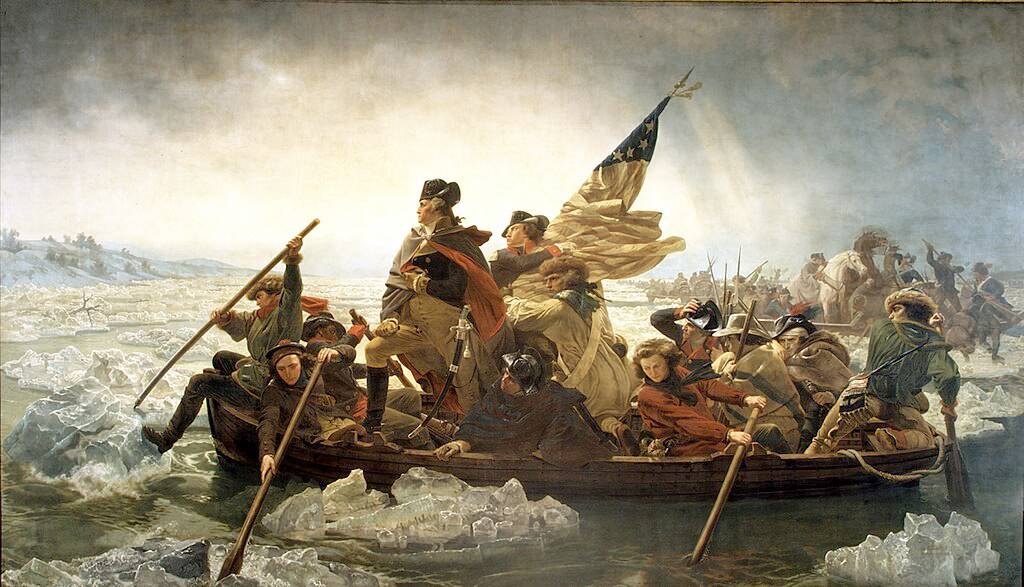
Many locals know that the War for Independence made its mark right here in Atlantic County. The 1778 Battle of Chestnut Neck near Port Republic has forever cemented our local claim to Revolutionary War lineage.
But whether the contributions of our brave freedom fighters mattered to the outcome of the war has been a topic for historian speculation.
New research tells us that what happened here, and the local men who answered the call to arms did, were important to the success of General George Washington in pivotal places like Princeton and Trenton. A recent project undertaken by the Atlantic County Historical Society has elevated Atlantic County’s claim to historic prominence from theory to rock-solid fact.
This conclusion comes to us by way of the 3rd Battalion Project, which collected military pension records from 42 members of the 3rd Battalion Gloucester County Militia, who served at a time when what is now Atlantic County was part of Gloucester County.
We know about them because they applied for benefits when Congress created the Revolutionary War Pension Act of 1832. Under the law, anyone who served in the militia, or the Continental Army or Navy, for at least six months during the Revolutionary War were entitled to a lifetime pension from the Federal Government.
Fifty years after the end of their service, the former militia — who were anywhere from 17 to 50 years old when they served — were invited to apply. In their old age, they had to appear before a judge and tell the story of their service by affidavit, with witnesses who could vouch for their story. The pension applications, now recorded in various digital archives, contained a story that was waiting to be told.
Norman Goos of Galloway, a retired professor of ancient Greek and pastor, and present-day historian for the Atlantic County Historical Society, decided to see what could be learned from the pension applications.
“We ended up with very detailed information about where our people served and fought, at Princeton and Trenton at Red Bank in Philadelphia, and in our own county, which was attacked several times by the British,” Goos said.
The 3rd Battalion Project was undertaken beginning on Oct. 1 in honor of the Semiquincentennial or America250, our nation’s 250th anniversary celebration.
The seeds were planted when Goos challenged a friend at the New Jersey Archives to find as many of the pension applications as she could with references to the 3rd Battalion. Initially they had 25, but through diligent research the number has grown to 42, via various sources, including the Library of Congress and Villanova University.
Finding the scanned pension applications was the first step in a long process. Once located in PDF form, a team of about 20 volunteers went through each one in a painstaking process of interpretation and transcription. It’s a challenge because language and punctuation used back then didn’t follow the rules of grammar and spelling we are accustomed to today. Many were signed with a simple “X.” Other documents were illegible.
But the hard work is paying off and has revealed new discoveries. They say New Jersey is the crossroads of the Revolution — the 3rd Battalion logged a lot of miles on those roads. They took on assignments that either kept Washington’s army supplied, diverted enemy attack, or weakened the British Navy to the point where the British avoided the New Jersey coast.
The project confirmed the role of Atlantic County privateers as a menace to the British supply lines. Privateers routinely hijacked British ships, offloaded the cargo, and moved it overland to supply Washington’s army. The ships were later auctioned off at Mays Landing to other privateers and used against the British.
“Chestnut Neck becomes the largest privateering port to dump the captured vessels and their loot between Boston and Charleston, South Carolina. And so you sometimes have six and eight ships a week being sailed in,” Goos said.
In Atlantic County, one of the first militia units was called the Egg Harbor Guard, created by Col. Richard Somers to prevent British raiders from stealing cattle from uninhabited barrier islands including Ocean City, Absecon Island, and Brigantine. Their service included coastal defense, utilizing fortified positions at Somers Point to repel British naval incursions and securing the Jersey Shore.
“We even found that we had an attack on Somers Point coming through the Ocean City, Longport Inlet that was repelled,” Goos said.
The 3rd Battalion is also credited with distracting the 1,500 Hessians — German mercenaries hired by the British — to the point where they were not able to come to the aid of the British when they were needed to move against George Washington. The battalion marched all the way up to Bordentown and harassed the Hessians, but stayed just out of range to the point where the Hessians gave chase.
They taunted the Hessians, fired at a distance, and lured them all the way to Mount Holly so Washington could take Trenton with minimal resistance.
The 3rd Battalion Project is expected to be finished by July 1 with copies available in a bound volume and printed.
When completed, there will be a 400-page book telling the stories of these men who were either fishermen or farmers, ship builders or businessmen — a proud history that counters the popular narrative that militia from this area played a passive role in the Revolutionary War.
Free searchable PDF copies will be made available to all county libraries, high schools and historical societies. A bound book will also be available. Goos hopes it has an impact.
“I hope it takes us from a minimal understanding — yeah there was a militia that just showed up for meetings, and that was it — to yes the militia in this county almost single-handedly protected one of Washington’s most critical food supply chains from these British ships that were taking them.” And played a pivotal role in some of Washington’s most important victories.
He also hopes publicity about this project encourages people to get involved. There are probably more members of the battalion to be discovered and more opportunities to write the story of Atlantic County’s Revolutionary War history — not just about the 3rd Battalion, but members of Washington’s Continental Army as well.
“My hope is in a year or so, we’ll need to add an addendum to the book because someone has discovered 20 more names or stories.”
3rd Battalion members from Atlantic County
Abraham Albertson, Thompson Albertson, Benjamin Bates, William Beaston, Zadok Bowen, John Casey, Jesse Conover, Henry Davis, James DeLap, Davis Denike, Samuel Denike, John Dennis, Edward Dowers, John English, Steven Ford, Enoch Gandy, Jacob Garretson, James Giberson, John Giberson, William Given, Edward Higbee, Jr., Isaac Hickman, John Ingersoll, John Jeffries, George Lake, James Leeds, Jeremiah Leeds, Robert Leeds, Samuel Lord, Simon Lucas, Cornelius McCollum, Patrick McCollum, Stephen Morris, William Newberry, Levi Price, Thompson Price, William Smith, Henry Snell, David Somers, Samuel Sooy, James Steelman, John Steelman, Zephaniah Steelman, John Thomas and John Tilton.
If you would like to help with the Atlantic County Historical Society’s ongoing Revolutionary War research, contact them via their Facebook page.
Copy editor and Contributing Writer James FitzPatrick has been a community journalist in Atlantic and Cape May counties for more than 30 years, including 20 years as editor of The Current Newspapers. He lives in Hammonton.