Remembering When
For more than a century, Atlantic City has been an entertainment capital; its countless venues have hosted show business immortals from Al Jolson and W.C. Fields to Frank Sinatra and Abbott & Costello to The Beatles and Kevin Hart. But once upon a time, the Boardwalk was also Broadway South.
In her 1973 Rutgers University doctoral thesis, “Atlantic City as A Tryout Town,” author Constance Barry Martin wrote that between 1900 and 1935, Our Town hosted more than 1,100 theatrical “tryouts” — that is, productions that were designed as shakedown cruises for straight plays, musicals and revues whose ultimate destinations were Broadway theaters. By 1909, she reported, the city was a “showman’s Mecca,” and by 1920, the “leading tryout town in the country.”
The perfect spot
That Atlantic City earned this distinction isn’t surprising; for numerous reasons, the city made sense for the role.
“By the early 1900s, because of the availability of [relatively] high speed rail travel between New York and Atlantic City and Philadelphia and Atlantic City, it became a viable place to put on a show,” offered Peter Schmitz, an adjunct professor of theater at Temple University who wrote the book “Adventures in Theater History: Philadelphia,” and hosts a well-researched and executed — and fascinating — podcast of the same name.
All things considered, reasoned Schmitz, Atlantic City was pretty much the perfect locale for new productions, especially in the first quarter of the 20th century.
“The shows back then weren’t serious shows,” he explained. “Broadway musicals and revues were light entertainment. They didn’t have much in the way of a book; plot was minimal.
“Mostly, they were vehicles for selling songs and for providing an opportunity to look at lovely ladies showing off their legs and doing elaborate dance routines and for seeing spectacular scenery. And that was why you went to these shows.
“Atlantic City was the perfect sort of place, the perfect atmosphere for that kind of thing. It was a fun place.”
But there were other advantages to using Atlantic City as a theatrical test kitchen. For instance, there was its built-in audience of sophisticated theatergoers (many of whom were vacationers from Philadelphia and New York), and its large Jewish population (Jews were widely acknowledged to be particularly vociferous in their love for, and financial support of, live theater).
Then there was the town’s reputation as the original “Sin City.” Members of theatrical companies could find all manner of recreational opportunities, many of which were illicit — especially during Prohibition which, thanks to vice lord Enoch “Nucky” Johnson, was pretty much nonexistent in AyCee.
Another point in the city’s favor during the early years of the 20th century was its unabashedly generous theater critics (at a time when Atlantic City was serviced by multiple daily newspapers and weekly publications).
Historically, a main concept behind out-of-town tryouts (Atlantic City was just one of a number of laboratories for new shows) was the expectation of receiving legitimate critical analysis from local reviewers which, in theory, anyway, would help a production’s creative team work out whatever issues needed their attention. But the Atlantic City critics of the early 20th century apparently found writing negative reviews well out of their collective wheelhouse.
“Atlantic City was known for having very amiable theater critics who would just write nice things about a show,” said Schmitz, who added it wasn’t uncommon for producers to hire working journalists as their local publicists.
Thankfully this somewhat unseemly aspect of show business began to dissipate by the cusp of the 1920s, as Atlantic City reviewers started to take seriously their responsibilities as unbiased arbiters.
Notable theaters
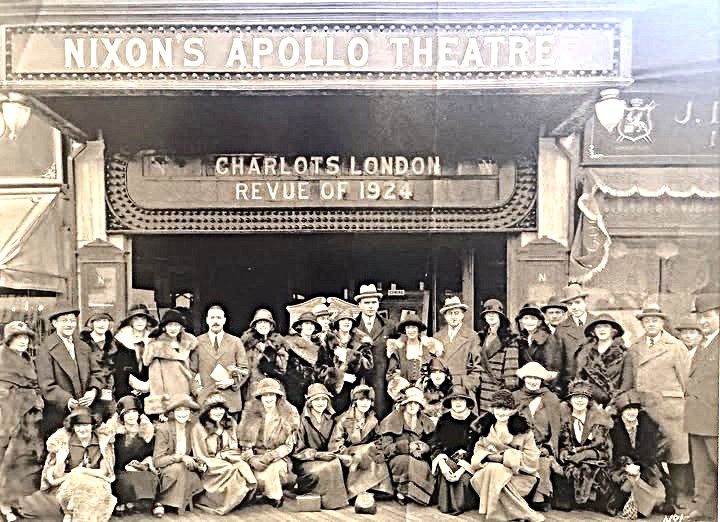
Early on, the main venues were such theaters as the Academy of Music (located on the Boardwalk at New York Ave.; actually, there were three as the first two were destroyed by fire), the Savoy (Boardwalk at South Carolina Ave.) and Young’s Million Dollar Pier Theater, which was part of the famed amusement complex on the Boardwalk at Arkansas Ave. In later years, the action moved to such houses as Nixon’s Apollo Theatre (on New York Ave. just off the Boardwalk) and the Globe at Boardwalk and Delaware Ave. which, in its final years, gained notoriety as a burlesque outpost.
Famous names
Among the famed impresarios who used Atlantic City as an incubator for new projects were George M. Cohan, Busby Berkeley and Florenz Ziegfeld. Another was Harry Frazee, who is best — if erroneously — remembered as the Boston Red Sox owner who sold Babe Ruth to the New York Yankees in order to finance his Broadway production of “No, No Nanette” (which, not only had a local tryout, but was actually set here).
But the less-remembered Charles Frohman was the Titan of Tryouts. In the first decade-plus of the century — until, as a passenger, he died in the catastrophic 1915 attack on the HMS Lusitania by a German submarine — he was far and away the most prolific of producers to workshop shows in Atlantic City.
The productions that Atlantic City helped midwife included in their casts some of the most acclaimed and important performers of all time. Among them were W.C. Fields, the erstwhile silent juggler who spoke onstage for the first time in 1905’s “The Ham Tree. In 1907, siblings Ethel, John and Lionel Barrymore performed in the double-bill of “Alice-Sit-By-the-Fire” (Ethel) and “Pantaloon” (John and Lionel); both were written by J.M. Barrie, best-known for creating Peter Pan. And in 1931, Mae West wrote and starred in “The Constant Sinner,” whose controversial plot elements included prostitution and interracial sex. Not surprisingly, many critics slammed the play for its themes and vulgarity.
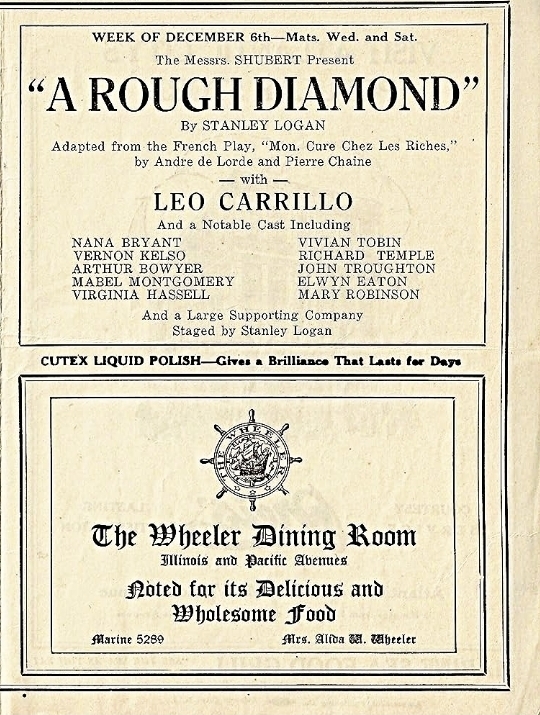
Other A-plus-listers who lit up stages during tryout runs included Eddie Cantor; Al Jolson, who reportedly would delight members of the public by manning the box office and selling tickets to his shows; future horror-film pioneer Lon Chaney; Fanny Brice, whom Barbra Streisand portrayed in “Funny Girl” and a 12-year-old Milton Berle.
These folks were just the tip of the iceberg: According to Schmitz, pretty much every big star of the era appeared at some point in an Atlantic City production. Local audiences also got to hear new music from the likes of Irving Berlin, Cole Porter and George Gershwin.
The end
But the good times couldn’t last. The onset of the Great Depression in the final months of the 1920s ultimately led to Atlantic City’s demise as the country’s premier tryout town. By the time the economy began to recover, such cities as Philadelphia, Boston, Washington, D.C. and New Haven, Conn. had rendered obsolete the need for new plays to be previewed in Atlantic City. And, of course, the city’s post-World War II decline as a vacation destination certainly played a role in keeping it from regaining its early-century preeminence in the theatrical world.
But for more than three decades, more often than not, the road to Broadway went right through Atlantic City.