
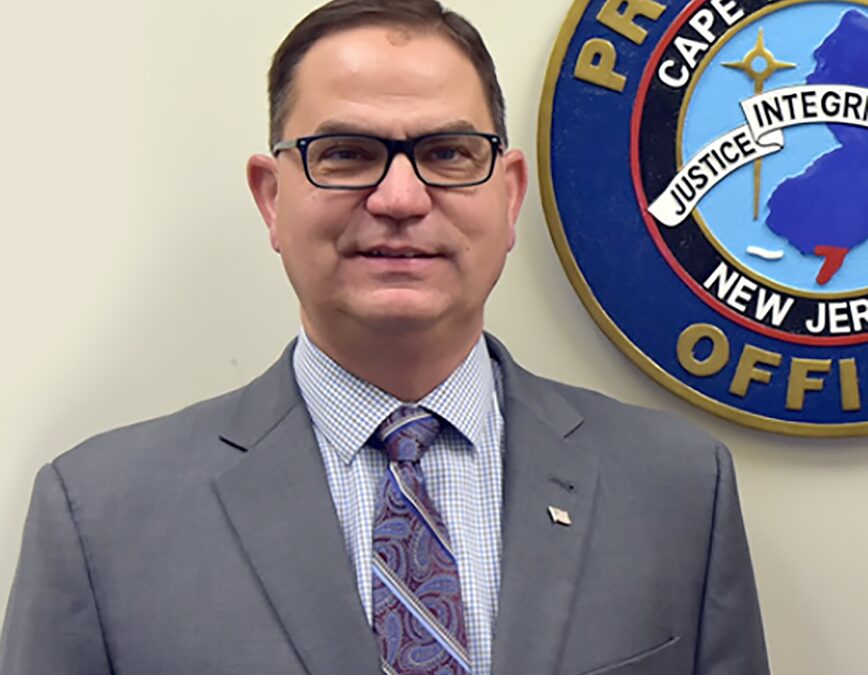
The Cape May County Prosecutor’s Office has launched a new Mental Health Diversion Program designed to redirect eligible defendants with serious mental health conditions away from the traditional criminal justice process and into treatment-based services.
In a Jan. 15 press release, Cape May County Prosecutor Jeffrey H. Sutherland announced the establishment of the program, noting that it stems from a statewide effort to address gaps in how the criminal justice system handles individuals whose mental illness contributes to criminal behavior.
According to the release, in 2025 the Cape May County Prosecutor’s Office and the Atlantic County Prosecutor’s Office were awarded a grant from the Office of the Attorney General to develop the prosecutor-led Mental Health Diversion Program, based on an existing model in Atlantic County.
The grant funds mental health screening, evaluation and case management services through Jewish Family Services (JFS) of Atlantic County, which was awarded the contract to provide services in both counties, according to the press release.
Deputy First Assistant Prosecutor Gretchen Pickering, who currently runs the program, emphasized that eligibility is limited and specific.
“One of the first things that has to be made clear is that this applies to people who have indictable charges,” Pickering said. “You actually have to have charges.”
She added that the goal is to divert individuals with serious and persistent mental illness or intellectual or developmental disabilities when there is a clear connection between the condition and the alleged offense.
Applications are submitted primarily through defense attorneys, though defendants may also apply themselves, and applicants must provide documentation showing a mental health history tied to the alleged crime.
Sutherland compared the program to other diversionary tools, such as veterans diversion and recovery court.
“It’s just another tool we have to help people who maybe ended up in the criminal justice system because of a condition they suffer from more than their bad intentions to engage in criminal activity,” he said.
The program is not a blanket alternative to prosecution. Sutherland stressed that not all offenses qualify. Certain violent crimes, domestic violence offenses, crimes against children and sexually based offenses are unlikely to be accepted, even if they are lower-degree charges.
“It’s not like someone with a mental health condition gets a free pass,” he said.

Pickering noted that applicants must have active charges and cannot apply after being sentenced to state prison.
Defendants may apply while incarcerated if their charges are pending. Pickering explained that being in jail does not automatically disqualify someone, but participation generally means they would not remain incarcerated during treatment. Sutherland said most qualifying cases involve nonviolent third- or fourth-degree offenses.
Participants accepted into the program must comply with treatment recommendations, attend required court appearances and remain under supervision.
In the press release, Sutherland stated that eligible defendants may be diverted “into appropriate case management and mental health services” and that, upon successful completion, “cooperative defendants can have their sentences downgraded or charges dismissed without prejudice.”
Sutherland also highlighted the program as part of a broader countywide approach to mental health, which includes the Alternative Responses to Reduce Instances of Violence and Escalation (ARRIVE) Together program. The initiative pairs officers “trained in crisis intervention and de-escalation techniques, with certified mental health screeners and crisis specialists to respond to 911 calls involving behavioral health incidents,” according to the New Jersey Association of Mental Health and Addiction Agencies.
Applications for the Mental Health Diversion Program are being accepted now. According to the press release, application materials and program information are available on the Resources tab of the Cape May County Prosecutor’s Office website, and completed applications may be submitted through eCOURTS or to the judiciary.