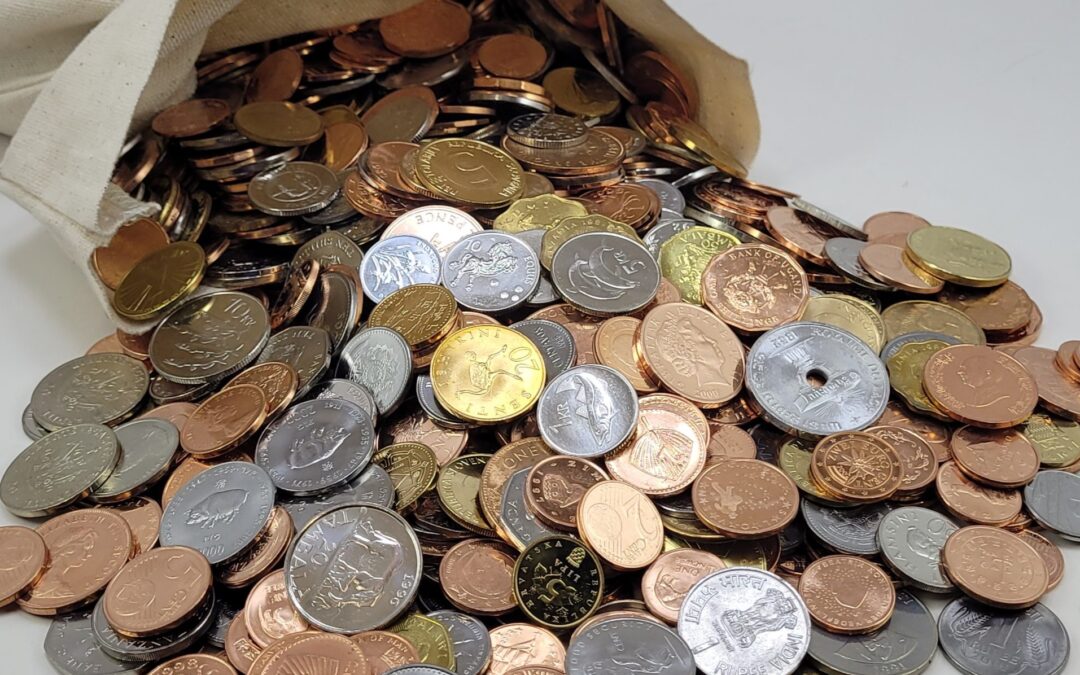
The coins that are the topic of today’s article are not rare or valuable, nor are they even sought after for their gold or silver content since they are made of precious metal. The coins I am writing about are the lowly everyday pocket change that has found its’ way to our shores either in the pockets of tourists returning home or from emigrants leaving the old country behind, but maybe bringing a memento as a remembrance.
It seems almost every collection we purchase has in it either a tin, a jar, an envelope or baggie containing a group of miscellaneous foreign coins. They can be struck in copper, nickel or aluminum and represent the lowest denomination of their country’s currency. Do they have any value? Not in the monetary sense because in many cases these coins have been replaced due to changes in that country’s system due to inflation, or in the case of the European Union, most member countries have adopted the Euro, doing away with the franc, mark, lira, etc. And even if they were current coins from that country, if someone came home with them, there is no place to go to cash them in. Banks and currency exchanges won’t take them because of the bulk weight involved, they only exchange paper currency.
The (inexpensive) value of these coins lies in the fact that certain collectors search through foreign coins looking for specific designs or certain countries. Because of the literal quantity of different coins being in the tens of thousands, this makes for a rich source to pursue one’s hobby, and that hobby can be collecting coins with animals, fish, plants, buildings, famous (and infamous) people including kings and queens, the choice of topics is large. I even know of collectors whose goal is to find coins from as many different countries as possible, or even countries whose name no longer exists, think Persia (Iran) or Siam (Thailand).
Other than finding coins for a collection in everyday pocket change, this is probably the least expensive way to collect. I know of dealers who throw all of them foreign coins in a box and charge a nominal price to pick out what you want. We formerly sold groups of foreign coins by weight, the largest being 10-pound bags containing hundreds of coins. (lots of sorting fun in that).
As I’ve said many times, the value in collecting lies in the enjoyment one gets through the pursuit, the old “thrill of the hunt”, trying to locate coins that add to the collection. And those who are geographically challenged, locating the country of origin on a map for the coin you found can be rewarding. The bigger challenge lies in identifying the location of countries that no longer exist, even though you found a coin from the time when they did.
Douglas Keefe and his wife Linda are owners of Beachcomber Coins and Collectibles in Egg Harbor Township. It is their only location.